
The 52-Year-Old Cartoon Cat Funding a 40% Margin Royalty Machine
Unusual Stocks is a Sunday series about public companies most people have never considered as investments. Some are strange businesses. Some are in strange places. All of them are worth knowing about.

The ticker is 8136. It trades on the Tokyo Stock Exchange, and it’s the company behind Hello Kitty: Sanrio Co., Ltd.
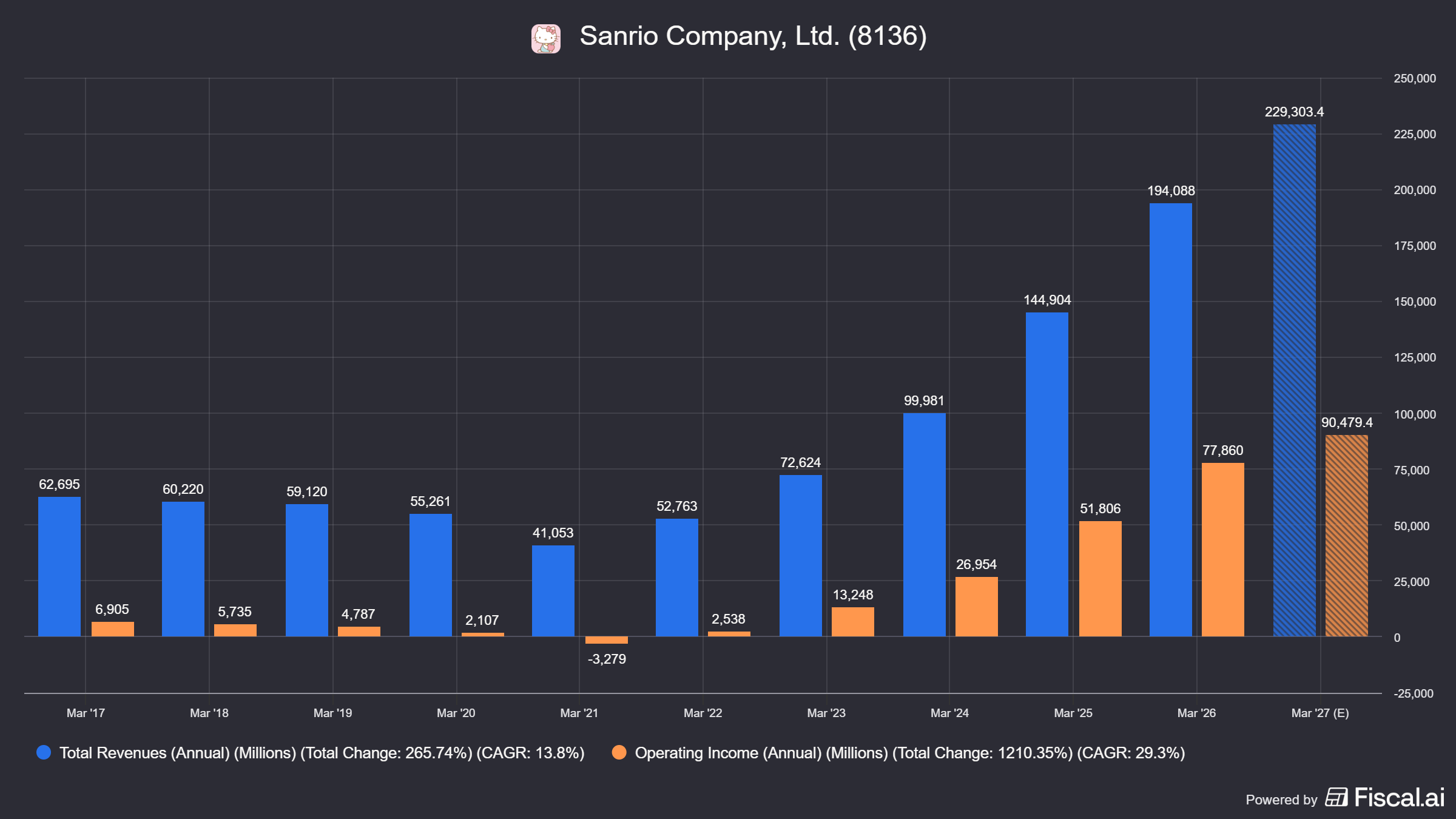
Before you close the tab and file this under “children’s stationery,” look at the underlying financial machine. In the fiscal year ended March 2026, Sanrio generated ¥194.1 billion in revenue and ¥78.5 billion in adjusted operating profit, up 33.9% and 41.0% year over year. That’s its fifth consecutive year of record sales and profit, and it managed all of it at a 77.3% gross margin and a 40.1% operating margin, the kind of numbers you’d expect from enterprise software rather than a company whose factory floor makes plush toys and pencil cases. The character business now spans more than 450 characters licensed into 130 countries and territories. And five years ago, this same company posted an operating loss.
In most professional investing circles, mention Sanrio and you’ll get one of two reactions: a knowing smile about coin purses and erasers, or a raised eyebrow about the compensation scandal that just forced a director’s resignation. Both miss what’s actually happening underneath. This is exactly why it fits the Unusual Stocks profile. A company that already blew through the market capitalization target management set for the next decade, with years to spare, is currently trading through a self-inflicted governance crisis that has nothing to do with whether people still want a Hello Kitty tote bag. Those two facts don’t cancel each other out. You need to hold both at once to understand this stock.
The “Second Founding”
The underlying company is 66 years old. Shintaro Tsuji founded it in 1960 as the Yamanashi Silk Company with ¥1 million in capital, selling silk goods. Two years later he switched to rubber sandals painted with flowers and noticed the thing that would define the next six decades: people paid more for the exact same product with a cute design stamped on it. He renamed the company Sanrio in 1973, made a point of hiring his own character designers rather than licensing someone else’s IP and paying an outside royalty, and put a white cat with no visible mouth into stores in 1974. That cat outlived every consumer-goods fad of the following fifty years and now sits in front of a licensing operation running at software-grade margins.
That doesn’t mean the ride has been smooth. Sanrio listed on the Tokyo Stock Exchange in 1982, moved up to the First Section in 1984, and spent much of the 2000s and 2010s looking like exactly the “over-reliant on one aging character” company the skeptics assumed it was. In June 2020, founder Shintaro Tsuji, who had run the company for 60 years, handed control to his 31-year-old grandson, Tomokuni Tsuji, making him the youngest CEO of a listed Japanese company. He inherited a business that, in the fiscal year just ending, posted an operating loss of ¥3.3 billion and a return on equity of negative 9.5%. Management itself now calls 2020 the company’s “second founding.”
What followed is a genuine V-shaped recovery, not just a phrase stretched to fit the data. Operating profit went from a ¥3.3 billion loss in FY3/2021 to ¥2.5 billion, then ¥13.2 billion, ¥27.0 billion, ¥51.8 billion, and ¥77.9 billion over the five years since, a compounding run with no down year. In May 2023, management put a specific number on where this was supposed to lead: a 10-year “Value Creation Story” targeting ¥1 trillion in market capitalization and ¥50 billion in operating profit. Both targets were beaten within two to three years, not ten. So in May 2025, instead of quietly taking the win, management scrapped its own scorecard and reset the long-term target to ¥5 trillion in market cap, roughly 3.6 times where the stock sits today.
The same company running this turnaround also holds a stake in KFC franchises around Tokyo and Saitama, owns the Japanese licensing rights to Peanuts, and runs an animatronics subsidiary, Kokoro Company, best known for building androids. Bandai Namco Holdings, a company most people would assume is a rival, owns a stake north of 4%. None of it moves the P&L. All of it says something about a management culture that has never been shy about strange side bets.
The IP Nobody Else Can Touch
Tsuji’s 1962 insight, that a cute design could turn a rubber sandal into something people would pay more for, hardened into a specific rule a decade later. Sanrio builds its own characters in-house rather than licensing someone else’s, so it never has to pay a royalty to anyone. More than 450 characters later, that rule is the whole moat. Nobody else can legally put Hello Kitty, Kuromi, or My Melody on a product, the same way nobody else can legally sell a Warhammer Space Marine, and the economics show up exactly where you’d expect: licensing income carries almost no cost of goods, and even blended with the lower-margin product sales business, the whole company runs a 77.3% gross margin and a 40.1% operating margin.
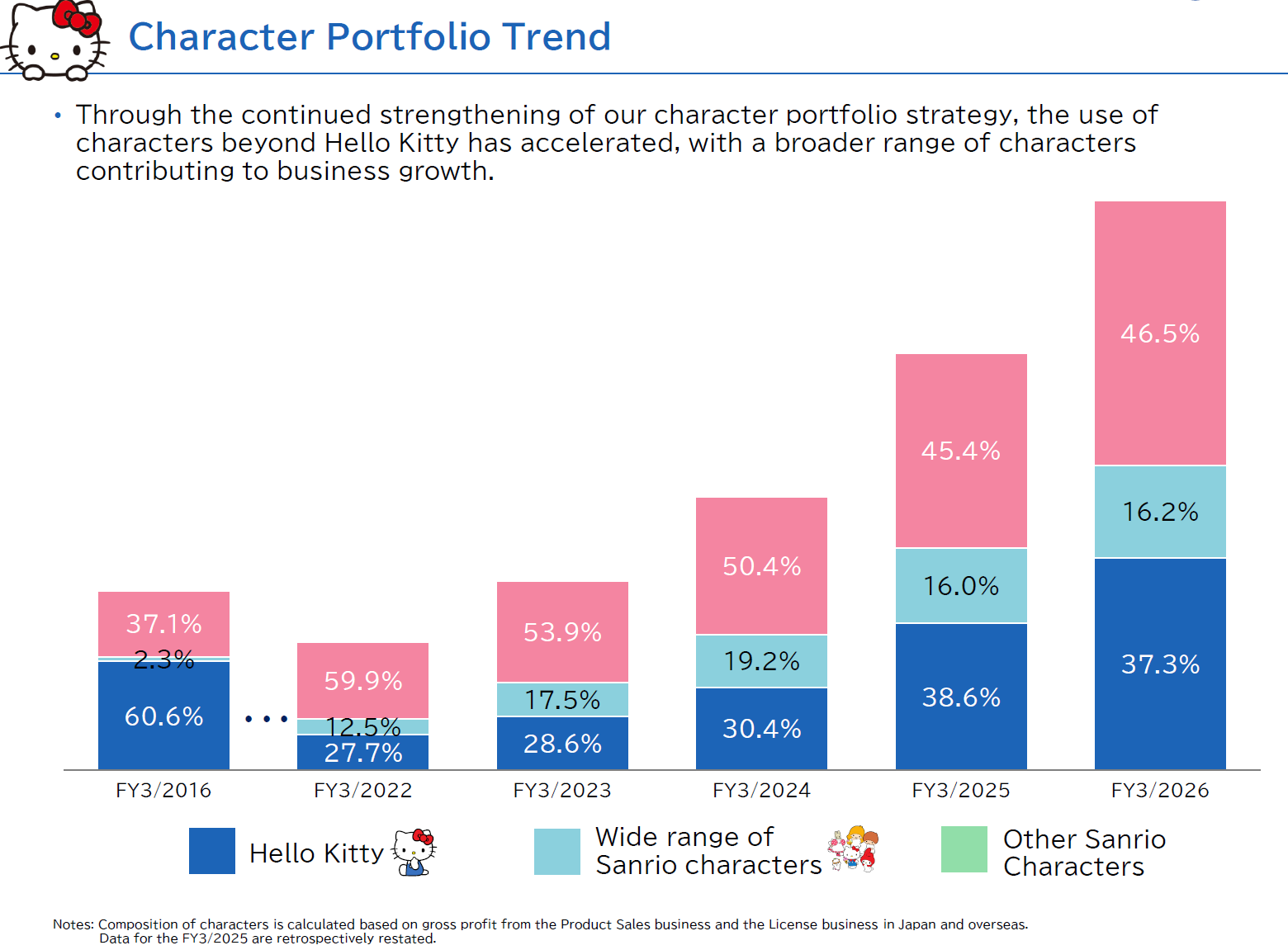
What makes Sanrio different from a typical single-franchise IP owner is that it has spent a decade deliberately diversifying away from its own biggest star. Hello Kitty’s share of group gross profit fell from 60.6% in the year to March 2016 to a low of 27.7% by March 2022, then climbed back and settled in the high 30s (38.6% in FY3/2025, 37.3% in FY3/2026). It’s less a decline than a controlled unwind of concentration risk followed by a stabilization, and it means Sanrio’s growth no longer hinges on one 52-year-old cat staying culturally relevant forever. Management is explicit that Kuromi, the mischievous rabbit-eared character who just turned 20, is being developed as the next key character after Hello Kitty.
The concentration that remains is regional rather than company-wide, and it maps directly onto where the risk actually sits. In North America, Hello Kitty still accounted for 57.3% of licensing gross profit in FY3/2026, down from 65.0% the year before but still the most concentrated of Sanrio’s major markets. In mainland China, the mix runs the opposite direction: Hello Kitty was just 33.2% of licensing profit, up from 23.0%, in a market where dozens of other characters still do the bulk of the work. The one market Sanrio most wants to grow is also the one still most dependent on its oldest asset.
None of this shows up on a normal balance sheet, but Sanrio tracks it anyway with a metric it calls "Sanrio Time," a rough estimate of the total hours per year that someone, somewhere, spends in contact with a Sanrio character, from buying a lunch box to browsing the webstore. Sanrio Time went from 113.6 billion hours in the year to March 2025 to 164.4 billion hours the year after, up 1.5x in twelve months. It's an unusual thing for a company to publish, and probably a more honest measure of cultural reach than any single revenue line.
The $1.6 Million Disconnect
On May 29, 2026, Sanrio’s Special Investigation Committee published its findings on a compliance issue the company had already flagged, and the numbers were small relative to the size of the business but the substance was not. A former Managing Director of Sanrio Co., Ltd., who concurrently served as CEO of Sanrio, Inc., the US subsidiary, had received US$1,682,018 (around ¥252 million) in additional compensation over several years, on top of what the Nomination and Remuneration Advisory Committee at the Japan head office had approved. The payments, structured partly as cost-of-living-adjustment bonuses, never went through the US subsidiary’s formal board and remuneration-committee approval process. Instead they were arranged through informal discussions among senior management, with no reporting to Tokyo. Other executive officers at the subsidiary received similar undisclosed bonuses. The committee’s conclusion was blunt: an evasion of internal controls occurred, both at the subsidiary and in the parent company’s oversight of it.
To Sanrio’s credit, the response has been specific rather than vague. The director in question resigned. CEO Tomokuni Tsuji returned 30% of his monthly compensation for three months, and the Senior Managing Director returned 10% for one month. The company will file amended securities reports correcting historical officer-compensation disclosures once the final figures are verified, and it laid out nine separate governance measures, including a direct CFO reporting line from overseas affiliates into Tokyo and strengthened board-approval procedures at every foreign subsidiary. Management states that no misstatement has been found in Sanrio’s consolidated results or in the US subsidiary’s own financials, and that the incident’s earnings impact, mostly investigation costs, will land in FY3/2027 and should be immaterial.
What it hasn’t fixed yet is the stock. At the June 25, 2026 annual meeting, management acknowledged directly that share price weakness has persisted, that some of it reflects short selling by large institutional investors, and that it believes the market is still pricing in governance risk rather than the underlying earnings power of the business. It’s a real, ongoing overhang, not because the dollar amount was large, but because it’s the kind of story that keeps getting asked about at every earnings call until the amended filings actually get submitted.
Software Margins on Plush Toys
Strip out the compliance headline and FY3/2026 was, on every conventional measure, the best year in the company’s history, the fifth straight year of record sales and profit. Revenue rose 33.9% to ¥194.1 billion. Gross margin expanded to 77.3%. Operating profit rose 50.3% to ¥77.9 billion, and adjusted operating profit, Sanrio’s own metric that strips out a timing quirk from consolidating overseas subsidiaries that close their books in December against a Japanese parent that closes in March, rose 41.0% to ¥78.5 billion. The results also beat the company’s own guidance, which itself had already been revised upward mid-year.
One number is worth sitting with, because the headline hides it. Net profit grew “only” 30.9%, lagging operating profit’s 50.3%. The gap isn’t operational. The prior year had booked a one-off ¥2.4 billion gain on the sale of investment securities that didn’t repeat, and the effective tax rate jumped from roughly 24.3% to 30.7%. Strip those two swings out and the underlying earnings trend looks even better than the reported net income line suggests.
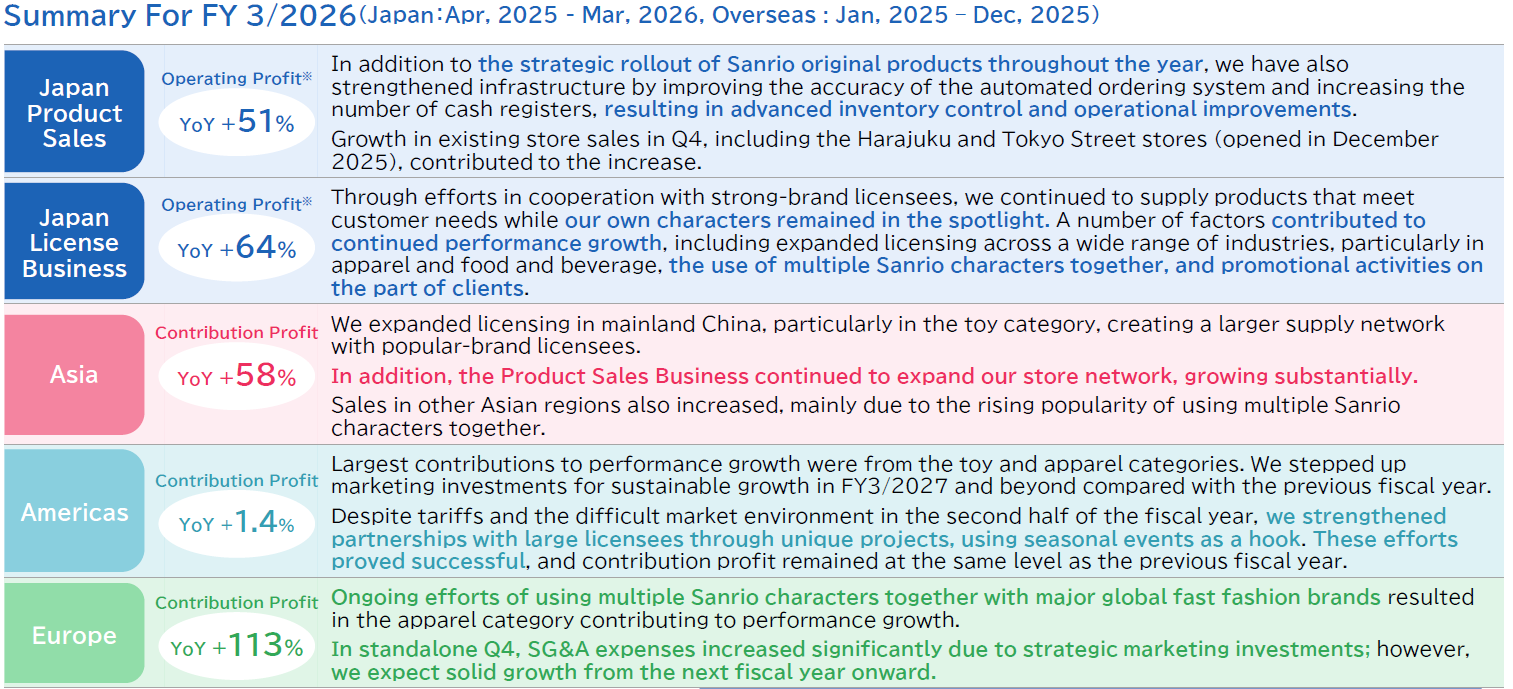
Regionally, the growth is not evenly spread, and the pattern says a lot about where the next decade will actually be won or lost. By sales, Japan grew 31.2% to ¥148.3 billion, Europe grew 83.6% to ¥11.7 billion, Asia grew 62.6% to ¥45.5 billion, and the combined Americas grew a comparatively pedestrian 5.4% to ¥31.1 billion. That blended figure hides a much sharper split underneath: North America alone grew barely 0.4%, hit by delays in licensee orders and production relocation tied to US tariff policy, while a much smaller Latin America business grew 84.5% off a low base.
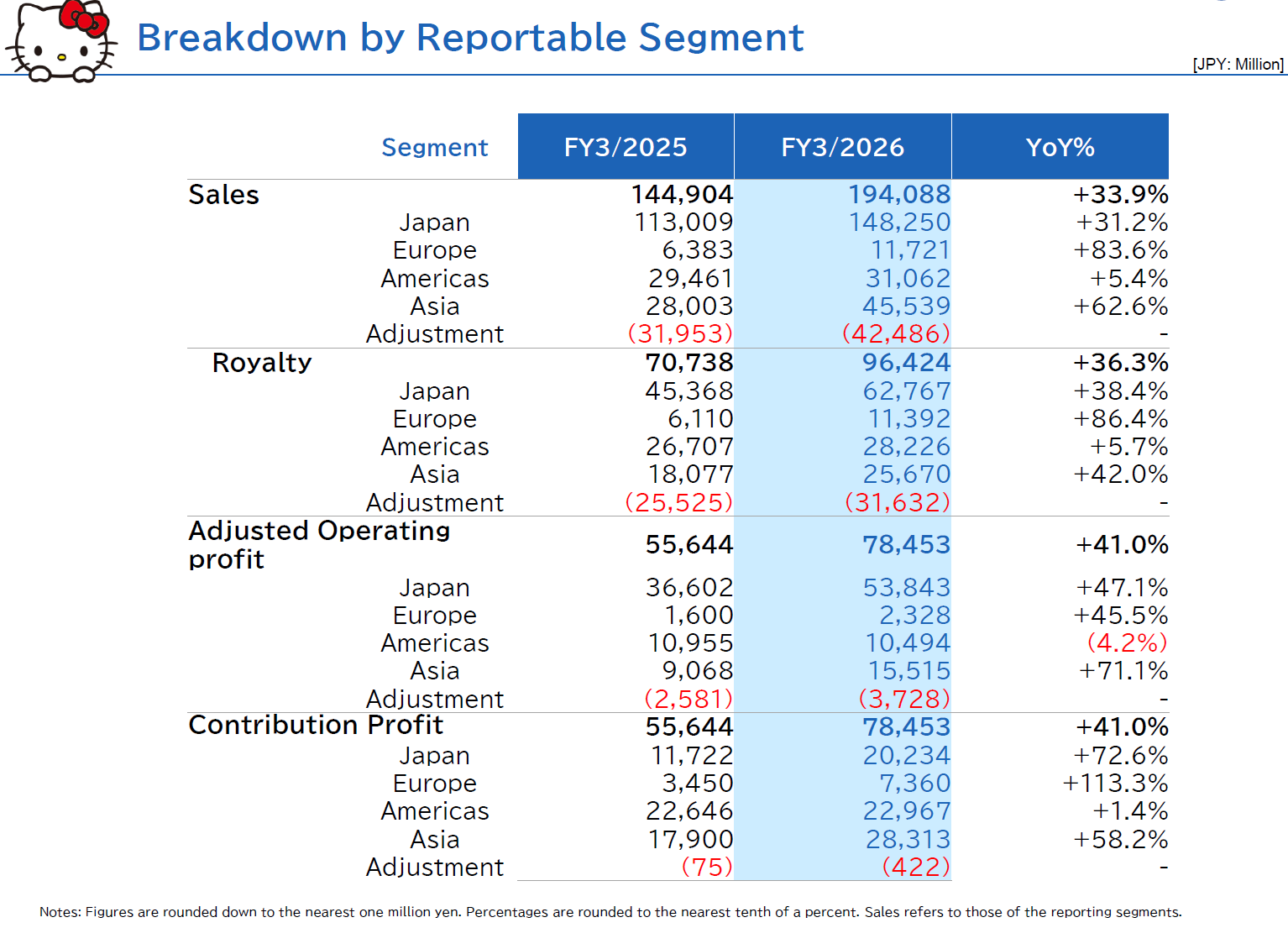
For profitability, Sanrio prefers a metric it calls “contribution profit” over each region’s raw segment operating profit, because overseas subsidiaries pay royalty fees up to the Japanese copyright holder as a cost of sales. That’s a real expense on the subsidiary’s own books, but not a real cost to the consolidated group, so contribution profit adds the royalty back. On this basis every region grew in FY3/2026: Japan up 72.6% to ¥20.2 billion, Europe up 113.3% to ¥7.4 billion, Asia up 58.2% to ¥28.3 billion, and the Americas essentially flat at 1.4% to ¥23.0 billion, tariffs again the culprit.
The balance sheet did as much work as the income statement. Net assets jumped 44.9% to ¥156.0 billion, largely because retained earnings rose ¥39.1 billion and roughly ¥21 billion of convertible bonds converted into equity, settled out of existing treasury stock rather than fresh share issuance. The equity ratio rose to 66.4% from 52.9%, net cash grew to ¥111.5 billion, and those two effects together mechanically compressed return on equity from 48.6% to 41.6% even as absolute profit hit a record, simply because the denominator grew faster than the numerator. That combination, retiring debt, clearing convertibles without printing new shares, and holding onto almost all of the profit instead of leveraging up, is usually what a conservatively run company looks like, not a company in trouble.
Chasing Ten Percent
The long-term vision Sanrio published in May 2025, “Lighting the Way to Bring Smiles to All,” breaks its ¥5 trillion market-cap ambition into region-specific market-share targets through FY3/2035, benchmarked against outside estimates of the character-licensing market in each country. Japan, where Sanrio already holds roughly 19% share, is targeted for up to five more points. Mainland China, at roughly 16% today, gets the same “up to +5pt” ceiling. Europe, starting from a base of about 1%, gets the same modest absolute ceiling, which would still mean multiplying its current share several times over.
North America is the outlier, and it’s the one management keeps returning to. Sanrio holds an estimated 4% share of the US character-licensing market today, against a target of 10% by FY3/2035. That means more than doubling share in the single market where the licensing business just posted essentially flat sales, where tariffs are an active drag, and where Hello Kitty is still the most concentrated single-character exposure in the portfolio. Management runs roughly 200 investor meetings a quarter, and by its own account the recurring pushback is skepticism about the US growth case specifically, driven by tariffs rather than any doubt about whether the characters are still popular.
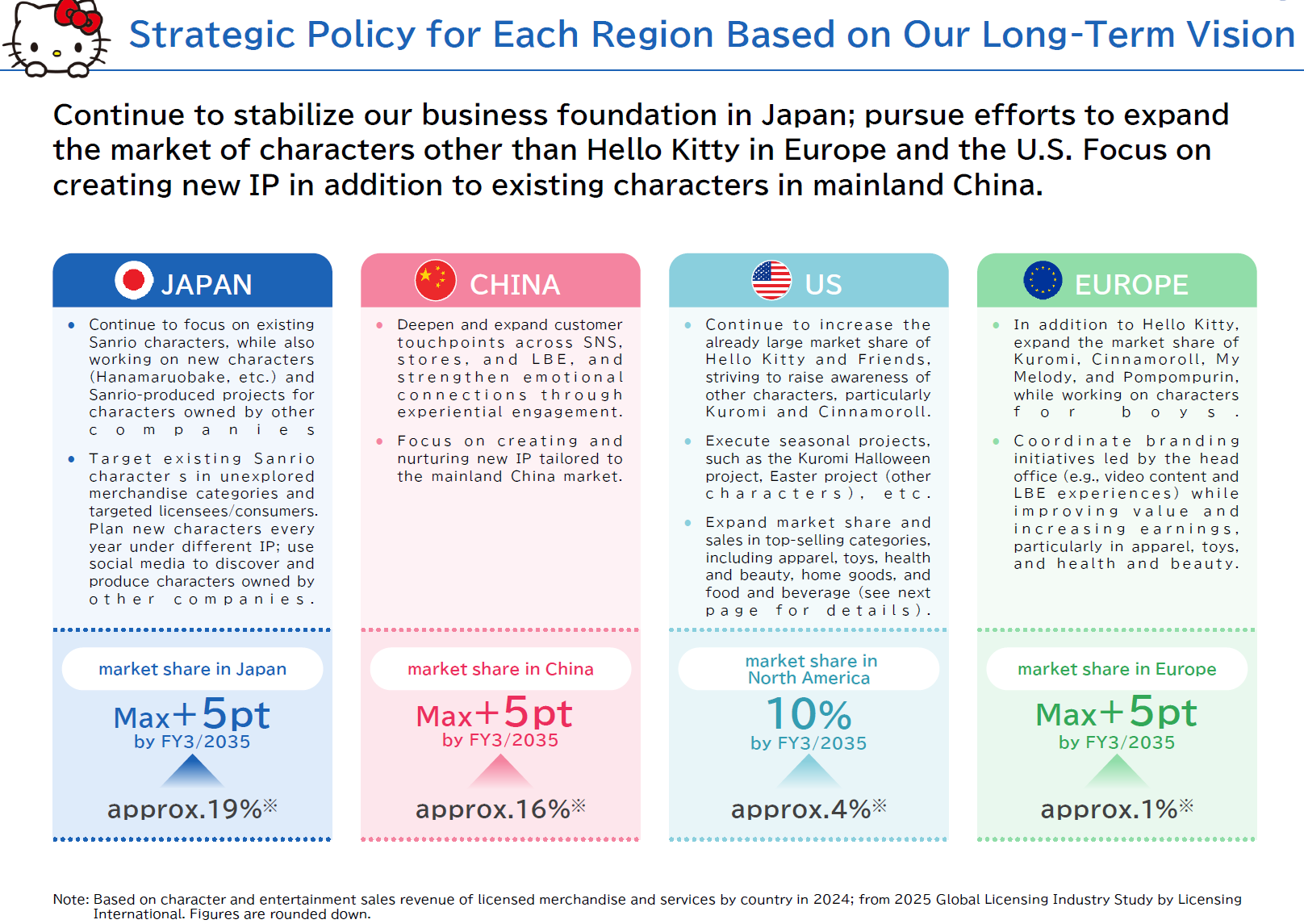
The plan to close that gap is a demographic-and-category matrix, not a single big bet. It means pushing Kuromi and Cinnamoroll harder to diversify beyond the “overall boost in a relatively weak market” that Hello Kitty alone still delivers, expanding into adjacent categories such as K-beauty-style health-and-beauty partnerships, home goods, and next-generation characters aimed at the kidult and male markets, and leaning into cultural moments: a Kuromi-branded Halloween push, sponsorships with the NBA, NHL, MLB, and F1 Academy, K-pop collaborations aimed at Gen Z. None of it is a single swing for the fences. It is, deliberately, a lot of small bets stacked on top of an IP base nobody else can legally replicate.
The Platformer Pivot
The ¥5 trillion target can’t be hit by the existing character business alone, and management says so explicitly. It wants to become a “global IP platformer,” with a stated ambition of 100 million users on a unified digital ID platform over the long term. Sanrio+, the membership service underpinning that goal, had reached about 3.26 million registered members by March 2026.
The most concrete near-term step is Sanrio Games, an in-house brand announced in April 2026. Its first release, a Nintendo Switch and Switch 2 party game, launches in autumn 2026, with roughly ten titles planned through FY3/2029, developed alongside external studios for engineering while Sanrio keeps IP and creative direction in-house. Management is upfront that the game business will barely register in FY3/2027 earnings. The costs land first, the revenue later, weighted toward the back half of the year around launch.
Further out, the single biggest catalyst is a still-untitled Hello Kitty film, co-produced with Warner Bros. Pictures Animation and slated for July 2028. It would be Sanrio’s first real entry into major theatrical animation, more than fifty years after Hello Kitty first appeared on a coin purse. There’s already proof the IP travels on screen: a 12-episode My Melody & Kuromi stop-motion series landed on Netflix in mid-2025, ranked second globally in the platform’s non-English weekly Top 10 in its first week, and reached the Top 10 in 59 countries, with a theme song from LE SSERAFIM. A separate licensing deal with Moonbug brings CoComelon into Japan alongside Sanrio characters starting in 2026.
The company is also spending on physical and virtual real estate. Virtual Sanrio Puroland, a permanent VR theme park built on VRChat, opened in December 2025, following four prior “Sanrio Virtual Festival” events that had drawn more than 10 million cumulative visitors since 2021. In Oita Prefecture, Harmonyland, which just turned 35, is being redeveloped under a “Park in the Sky” concept, with an initial investment phase of roughly ¥10 billion including partner contributions.
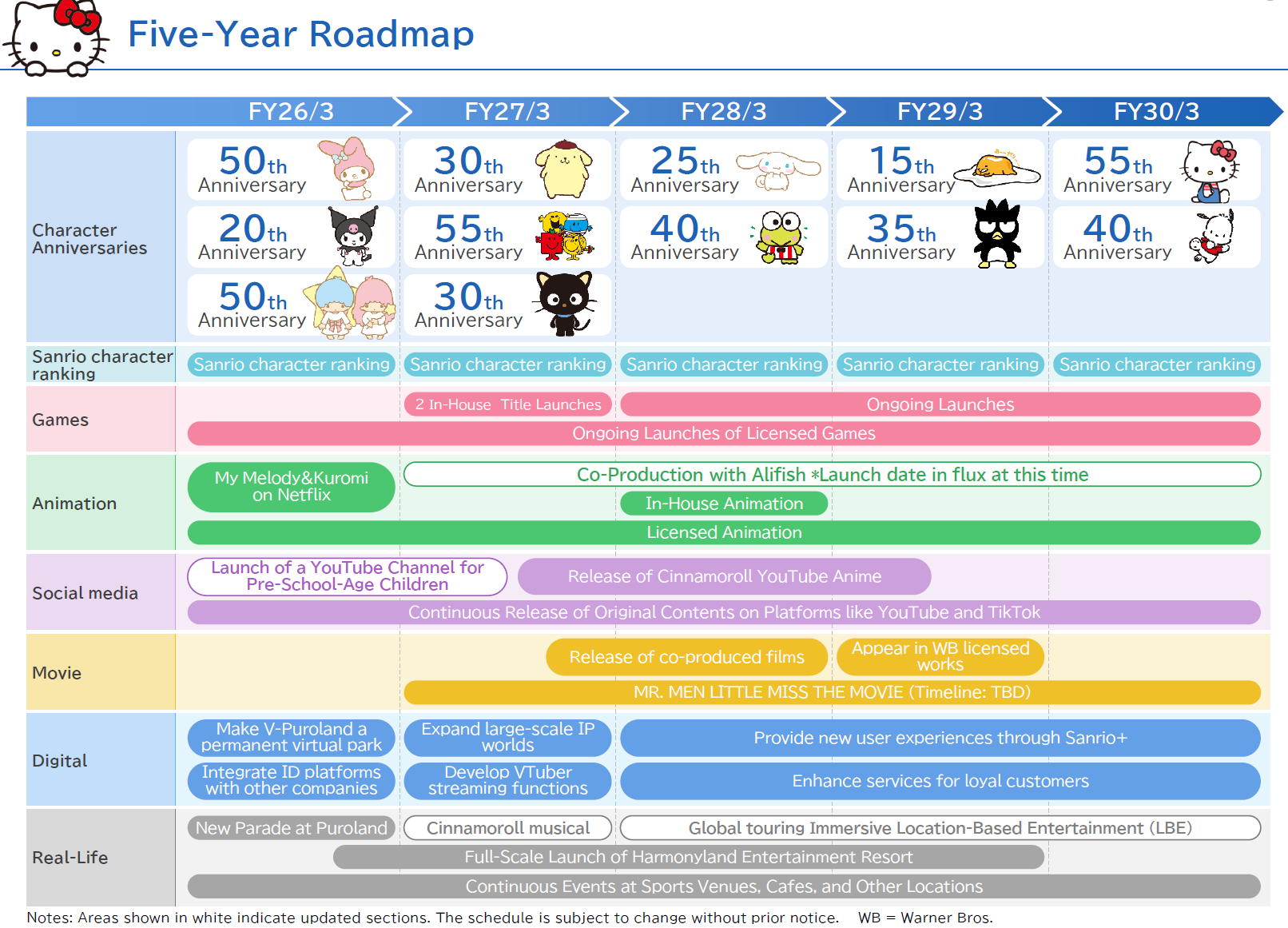
Every one of these is optionality, not yet earnings. That's precisely the risk in the next section.
Tariffs, Timing, and the Growth Trap
The governance overhang isn’t fully resolved. Amended securities reports covering prior years’ officer compensation are still pending, further action against former US subsidiary officers is still under consideration, and civil recourse against the former director is still being evaluated. Every one of those is a live loose end that can resurface at the next results briefing.
Tariffs are a real, ongoing drag exactly where the growth ambition is largest. North America sales grew just 0.4% in FY3/2026 and contribution profit rose only 1.4%, both explicitly attributed to delayed licensee orders and production relocation tied to US tariff policy. FY3/2027 guidance assumes the drag continues, which is uncomfortable given the long-term plan needs US share to more than double from here.
Almost everything described in “The Platformer Pivot” is unproven and front-loaded with cost rather than revenue. Sanrio Games won’t meaningfully contribute to earnings until at least FY3/2028. The Warner Bros. film doesn’t land until July 2028, and as management itself notes, delivery timing on projects like this is not fully in their control. The Harmonyland resort and any global theme-park expansion require multi-year capital commitments before generating a single yen of return.
A large share of this year’s best-looking growth is running through mainland China. Asia contribution profit was up 58.2%, driven substantially by product-sales store expansion (59 stores, up 31 in a year) and toy-category licensing through master licensee Alifish. Chinese consumer enthusiasm for character merchandise and “trendy toys” has run in strong multi-year cycles before and cooled just as fast, and a slowdown there would remove the single largest contributor to this year’s headline growth.
Currency cuts both ways, and FY3/2027 guidance is built on the yen weakening further still (USD/JPY assumed at 155 versus 150, EUR/JPY at 185 versus 169, CNY/JPY at 22.5 versus 20.9). If the yen strengthens instead, reported growth will undershoot guidance even if the underlying licensing business performs exactly as planned.
And this is not, by any stretch, a hidden-value pitch. At roughly 25x trailing earnings and nearly 9x book value, the market has already re-rated Sanrio from overlooked stationery company to recognized compounder. Management itself argues the stock remains undervalued relative to its growth outlook, and short sellers have reportedly taken the other side of that argument. Both can’t be right, and the governance cloud is the reason this particular disagreement hasn’t resolved yet.
The Price Tag
At ¥1,159.50 a share (post-5-for-1 stock split in April 2026), Sanrio carries a market cap of roughly ¥1.39 trillion and an enterprise value of about ¥1.28 trillion. EV sits below market cap because the company holds more cash than debt outright. The split itself was mostly a housekeeping move: the minimum investment unit had drifted up toward ¥500,000, well above the roughly ¥100,000 level the Tokyo Stock Exchange has been pushing listed companies toward, so the board cut every share into five. Worth flagging if you pull up an older Sanrio chart and the price looks five times higher than what’s quoted here: same company, just a different share count.
That works out to 25.2x trailing earnings and 15.4x trailing EV/EBITDA, or 22.2x and 14.0x on next-twelve-month estimates. Against a five-year average return on equity of 30.2% and return on invested capital of 28.9%, that isn’t a demanding multiple for the quality of the business, though it’s nowhere near the “market hasn’t noticed yet” discount that makes some Unusual Stocks picks interesting. A PEG ratio of 1.6, using the company’s own long-term EPS growth estimate of 14.3% rather than the much faster near-term rate, reads closer to fair-for-growth than cheap.
What’s genuinely unusual is the balance sheet discipline sitting underneath all of it: debt-to-equity of just 0.1, interest coverage north of 400 times, and essentially no share dilution over five years despite a company that has repeatedly issued convertible bonds and then settled them out of treasury stock rather than printing new shares. Free cash flow has compounded at a five-year rate approaching 270%, an eye-popping figure that mostly reflects how close to zero free cash flow was five years ago, the same “second founding” starting line as everything else in this piece, rather than a repeatable growth rate going forward.
The dividend is a small piece of the total-return story, and management has said as much: a 30%-plus payout policy, a yield of just 1.4%, and dividends that have grown at an 80.8% annualized rate over three years purely because profit has grown that fast. But the real retail hook is the uniquely Japanese shareholder benefit program, or yutai. Buy and hold just 500 shares (post-split) and Sanrio will send you complimentary digital entry passes to its Puroland and Harmonyland theme parks, plus ¥1,000 digital shopping coupons via its Sanrio+ app. Hold those shares for three years, and the company literally sends you an exclusive acrylic stand. Scale that up to 30,000 shares, and management will mail you exclusive plush toys and schedule a one-on-one virtual video call with a Sanrio character. It’s a delightfully eccentric perk for retail investors, sitting quietly on the cap table of a ¥1.4 trillion enterprise.
The actual bet here is on something narrower than a dividend or an undiscovered value story: whether a family-controlled licensing business that already beat its own ten-year plan in three years, and that owns more of its own IP than almost anyone in consumer goods, can clean up a compliance failure at one subsidiary and keep converting a 52-year-old cartoon cat, plus the forty-plus characters that came after her, into cash at the rate it has for the last five years.
So far, every quarter since the “second founding” has landed better than the one before it. The governance mess is the first real test of whether that keeps being true once people are actually paying attention.
Disclaimer
The information provided in this content is intended solely for educational and informational purposes. It is not financial, investment, or trading advice. I am not a licensed financial advisor, professional analyst, or registered with any securities regulator (e.g., SEC in the U.S., BaFin in Germany), and the views expressed are my personal opinions, not guarantees of future performance. Investing involves significant risks, including the potential loss of capital, and past performance does not predict future results. Any mention of potential benefits does not outweigh these risks and may not be suitable for your individual circumstances, risk profile, or needs.
You should conduct your own research or consult a licensed financial advisor before making any investment decisions, considering tax and securities laws in your jurisdiction (e.g., German capital gains tax, U.S. IRS rules). For binding advice, consult professionals in your jurisdiction, ideally in your local language. I am not responsible for any financial outcomes resulting from actions taken based on this content.
By engaging with this content, you acknowledge and agree that you are solely responsible for your own investment choices. I am not currently invested in any of the assets or securities discussed but reserve the right to buy or sell shares at any time without further notice. While all information is believed to be reliable and was prepared in good faith, its accuracy and completeness are not guaranteed.